































































Fifteen years ago, if you were a die-hard hockey fan, you may have come across a blogger named Eric Tulsky. “Broad Street Hockey”, a Philadelphia Flyers fan site, was his creative outlet to share his analytical expertise.
You may have stumbled across his breakdown of the Flyers zone entries, or his claim that Jakub Voracek was better than Claude Giroux. Both were out of the box at the time, especially given his reliance on advanced analytics.
TOP NEWS


His background in biotechnology fueled a passion to solve, decode, and master every aspect of his life — including hockey. But at the time, the hockey world hadn’t opened its arms to the prospect of embracing analytics.
The eye test and pure counting stats were the basis of most analysis, and anything else was seen as overcomplicating a simple game.
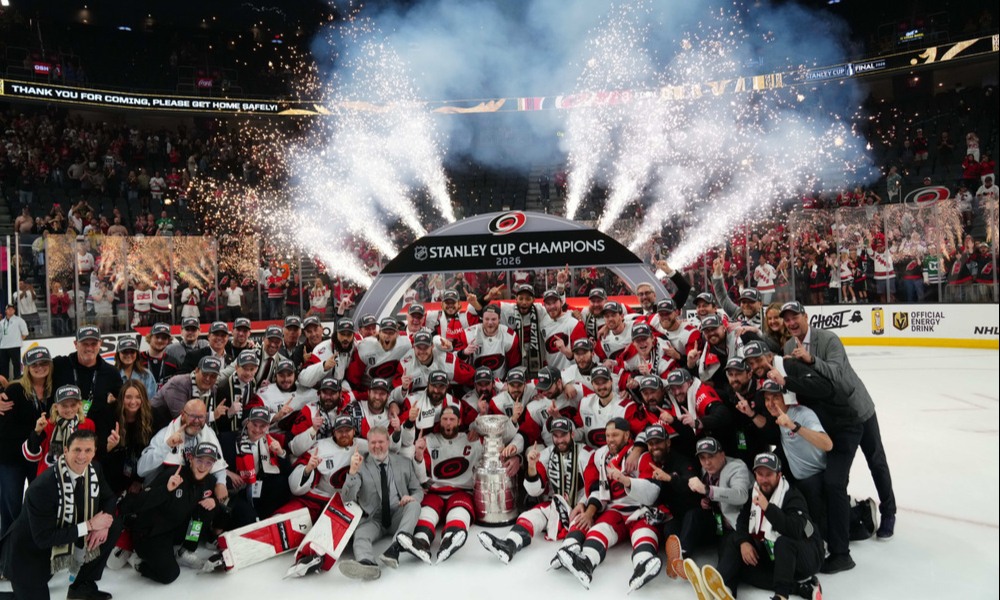
Last night, that blogger won the Stanley Cup as a general manager in only his second year on the job, employing the very analytics once considered baseless.
Math is for nerds — and for winners
When Tulsky traded Mikko Rantanen for Logan Stankoven two months after acquiring Rantanen from Colorado, it was seen as a loss. Any trade where your team gives up the best player is a loss, right?
History would certainly say so.
But, like every other facet of his life, Tulsky treated hockey as a problem to be solved. Meanwhile, management around the league followed the same trends over and over, as if the sport abided by a set of rules.
The framework for success was simple: don’t have too many small forwards, pay your superstars and target an elite goalie. While there were inklings of truth to all these sentiments, Tulsky knew that like any good math problem — there was more than one way to get to the solution.
For decades, teams have raved about “chemistry” and “fit” without any real backing. They were both essentially intangible qualities. With his extensive background in analytics, Tulsky has turned both into a genuine factor for success — Stankoven is the epitome of it.
In his draft year, teams knew what to expect of the 5-foot-8 winger.
He was tenacious, hard-working, and possessed an elite shot, but his frame limited his potential as a top-line player. Throughout his time in Dallas, it looked as though that assessment was right.
Stankoven showed all the tools for success, but couldn’t transfer the offensive touch to the system of Dallas. Now, on Carolina, he led the team in goals en route to their Stanley Cup, but what changed?
He didn’t become an elite-goal scorer overnight, but rather, was placed into a system that perfectly suits his strengths. Carolina’s forecheck has always been the crux of their offense, and implementing Stankoven only brought out the best of his game.
Rantanen, on the other hand, thrived in transition and on the power play. After his slow start in Carolina, Tulsky made the controversial decision to trade Rantanen and recoup assets.
That trade is now considered a major factor in the Stanley Cup win, and a testament to Tulsky’s management philosophy.
K’Andre Miller and the No. 1 defenseman myth
Using the extra six million dollars saved from the Rantanen trade, Tulsky traded for and extended New York Rangers defenseman K’Andre Miller. His $7.5 million average annual value was seen as a bit steep, especially given Miller’s limited track record.
Similar to Stankoven in Dallas, Miller had shown all the tools of becoming a good NHL player. His skating, physicality, and size all pointed to his potential as a top pairing defenseman.
But his game just hadn’t come together, and the Rangers were ready to move on.
So, Tulsky took another gamble, knowing Miller would fit into Carolina’s system. Unsurprisingly, he had the best season of his career, as his pairing with Sean Walker recorded the fifth best expected goals percentage in the league among pairings with at least 800 minutes played.
In the playoffs, he cemented himself as arguably the best defenseman on the team. His puck movement was critical to opening up Carolina’s offensive threats, as in prior years, Shayne Gostisbehere was the only elite puck-moving defenseman.
His nine points and over 24 minutes of ice time a night through the playoffs were instrumental in the Hurricanes’ 16-3 run.
For years, a No. 1 defenseman has been seen as pivotal to any successful team. Think of Cale Makar and Victor Hedman in recent years, leading their team from the blueline night in and night out.
Now, the Hurricanes have proven that’s a concept of the past. Not to say Miller is a bad defenseman, but he’s far from an elite No. 1.
Instead of one great defenseman, the Hurricanes have assembled a core of six competent defensemen who are willing to buy into their system. Jaccob Slavin, Miller and Gostisbehere certainly led that group, but it’s hard to classify any of them as a prototypical No. 1 defenseman.
The lesson at hand
For all other 31 general managers, this championship is a wake-up call. The game is changing, and there’s more than one formula to success.
Analytics are here, and prioritizing them will only further your team. It’s too early to say if the win will foster a new era of forward thinking management in the NHL.
But if not, it’ll only benefit the Hurricanes, and the former blogger who’s solving hockey with numbers.


